
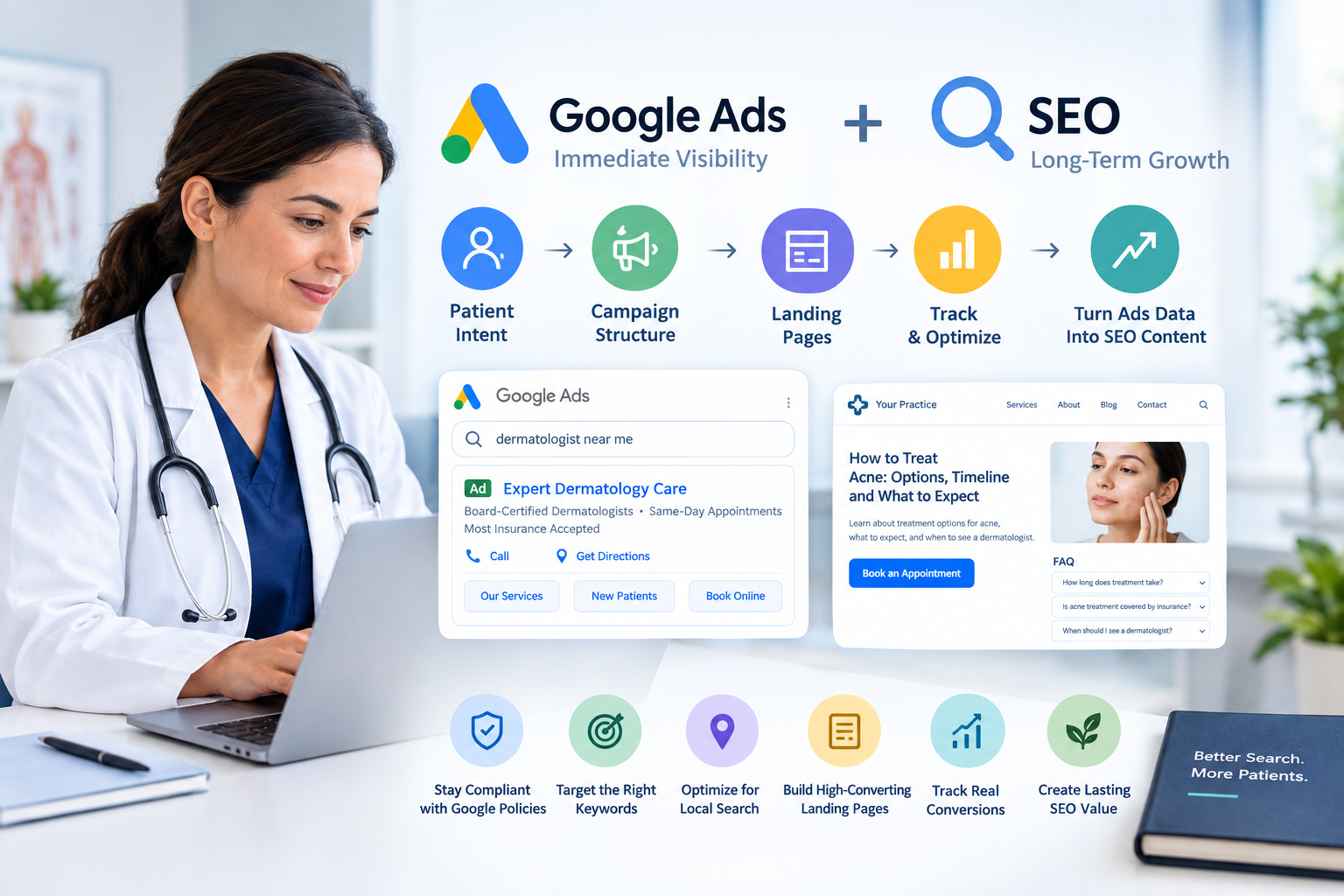
Search a version of "google ads for doctors seo outline" and most results read the same way: a loose definition, a claim that ads and SEO "work better together," and a push toward hiring the agency writing the post. Few explain what actually decides whether a medical practice's campaigns work: Google's healthcare ad rules, how campaign structure should differ from a typical account, or how to turn ad spend into content that keeps ranking long after the click is paid for.
At Rafenthic, this is the kind of account structure we spend a lot of time untangling for medical clients, so this guide covers it the way we'd actually build it: the policy details doctors trip over, campaign architecture that fits a practice, the negative keywords nobody writes about, and the bridge between paid data and long-term SEO. It's an extension of treating a website, SEO, content, and branding as one connected growth system, with no manufactured case studies or invented benchmark numbers.
What Is a Google Ads for Doctors SEO Outline?
A Google Ads for doctors SEO outline is a structured plan that combines paid search campaigns with organic search optimization so a medical practice can reach patients at every stage of their search, from someone typing a symptom at midnight to someone comparing providers before booking. If the terminology here is new, start with the fundamentals of how search engine optimization actually works. The outline covers keyword mapping by intent, campaign and ad group structure, landing page requirements, conversion tracking, budget logic, and a system for feeding what you learn from ads back into your SEO content plan.
The reason the pairing matters is simple. Ads give visibility the day you launch, but every click carries a cost that never disappears. SEO takes longer to build, but a ranking page keeps bringing in patients without a per-click charge attached. Practices that run these as separate budgets, managed by separate people, tend to rediscover the same keyword insights twice and waste money doing it.
Why Ads and SEO Can't Be Separate Line Items in Healthcare
A few things about medical search behavior make the "just run ads" or "just do SEO" approach weaker on its own:
-
- Intent shifts quickly. The same person might search "why does my knee hurt going up stairs" one week, then "orthopedic doctor near me accepting new patients" the next. A proper content strategy built around search intent catches the first; ads usually win the second.
- Trust matters more here than in most industries. A single ad click rarely converts on its own; patients check reviews first. For solo practitioners, that trust often rests on the doctor's own name, which is where treating a physician's reputation like a searchable personal brand becomes useful.
- Your ad account is free keyword research. The search terms report shows what patients type before they call, more reliable than guessing from a keyword tool alone, and one of the first things we check when auditing a healthcare account.
Before You Launch: The Policy Layer Most Guides Skip
This is the section almost none of the competing guides cover with real depth, and it's the one that causes disapproved ads or suspended accounts. Google treats healthcare advertising as a sensitive category, and rules differ by what's being promoted.
-
- General practice and specialty ads usually don't require special certification, but ad copy and landing pages still can't make unverifiable claims ("guaranteed cure," "pain-free in 24 hours") or use before/after imagery that violates health-claim policies. This overlaps closely with trust issues we've walked through in fixing E-E-A-T gaps on a med spa's website, where overstated claims and thin author credentials were the core problem.
- Telemedicine and prescription-adjacent services may need Google's healthcare provider certification before ads run in a given country.
- Personalized ad restrictions apply, since ads can't appear to reveal something Google inferred about a person's health, limiting remarketing options.
- Landing pages need a genuine, accessible privacy policy, and forms shouldn't collect more health information than needed to book a consultation.
Practical takeaway: check Google's current Healthcare and Medicines policy before building a campaign, and start any required certification early. Running restricted ads without it can cause account-wide disapprovals.
Step 1: Map Keywords by Patient Intent, Not Just Volume
Keyword research for a medical practice needs a different lens than typical PPC work. Group terms by where the patient sits in their decision, and by which search feature is likely to show up. Understanding how different SERP features shape what a searcher actually sees helps decide which intents are worth bidding on at all.
| Intent Type | Example Search | Best Channel |
|---|---|---|
| Symptom or informational | “why does my knee hurt when I climb stairs” | SEO content |
| Condition + treatment | “treatment options for plantar fasciitis” | SEO content, supported by ads on high-value variants |
| Local and urgent | “urgent care open now near me” | Google Ads (Search + Local) |
| Provider comparison | “best pediatric dentist [city]” | Ads + Google Business Profile and reviews |
| Insurance or logistics | “does [insurance] cover a dermatologist visit” | SEO FAQ content |
| Branded | “[practice name] appointment” | Low-cost branded ads + strong organic listing |
A common weak spot is heavy bidding on broad informational terms that rarely turn into bookings, while narrower local and comparison terms that actually fill the schedule stay under-funded. Budget should skew toward the right two columns; content should own the left ones.
Step 2: Structure Campaigns Around Specialty and Service, Not One Big Bucket
A frequent problem in doctor accounts is a single broad campaign covering every service, the same root issue behind the keyword cannibalization we untangled on a law firm's service pages: when everything competes for the same broad terms, nothing performs as well as it should. A cleaner structure separates campaigns by service line, then breaks each into tightly themed ad groups. For example:
-
- Campaign: Dermatology, General: Acne Treatment, Skin Cancer Screening, Eczema and Psoriasis Care
- Campaign: Dermatology, Cosmetic: Botox and Filler, Laser Treatments
- Campaign: Branded: Practice name and variations
Each ad group should point to its own landing page, covered below. This tighter structure also helps Quality Score, since Google rewards ads where keyword, copy, and landing page align, and a better score lowers what you pay for the same position.
For multi-location practices, add a location layer under each service campaign instead of one catch-all campaign, giving you control over budget and messaging city by city.
Step 3: Build a Negative Keyword List Specific to Healthcare
Negative keywords save more wasted spend than almost any other single lever, yet they're rarely covered with real specifics. A reasonable starting list should exclude terms tied to:
-
- Free or low-cost seeking behavior: "free," "cheap," "clinic near me no insurance" (unless the practice serves uninsured patients)
- Job and career searches: "jobs," "hiring," "salary," "how to become a [specialty]"
- DIY and home remedy searches: "at home," "natural remedy," "how to treat myself"
- Academic or research intent: "case study," "medical school," "definition of"
- Wrong-service overlap: a dermatologist should exclude "veterinary dermatologist," a physical therapist should exclude "PT assistant program"
Check the search terms report weekly for the first month of a new campaign, then monthly once things stabilize, the same discipline we'd apply during a full SEO audit: a scheduled, repeatable review catches problems before they get expensive.
Step 4: Landing Pages That Convert and Stay Compliant
Sending every ad to the homepage is one of the costliest habits in medical PPC. Each ad group needs a dedicated landing page that:
-
- Matches the exact service or condition named in the ad
- States location, hours, and accepted insurance clearly, since patients bounce fast when this is buried
- Has one clear action (call, book, or request a consultation), not three competing ones
- Loads quickly on mobile, given how many "near me" healthcare searches happen on a phone
- Avoids exaggerated outcome claims and keeps testimonials general
- Includes a visible, accessible privacy notice on any page with a form
Most of this comes down to solid fundamentals covered in any on-page SEO checklist, particularly page speed, heading structure, and mobile usability. It's also worth applying the same care to how the page title itself is written, since a clear, specific title reinforces relevance for both Quality Score and any organic ranking the page eventually earns. A short, service-specific FAQ block near the bottom also helps conversion, since it answers objections and signals relevance at the same time.
Step 5: Use Ad Extensions Built for a Medical Practice
Extensions cost nothing to add and meaningfully lift click-through rate, but the ones most relevant to healthcare are often skipped:
-
- Call extensions, since a large share of healthcare inquiries still happen by phone
- Location extensions, tied to the Google Business Profile, reinforcing the same local SEO fundamentals that matter for any small business
- Sitelink extensions pointing to specific services or new patient forms
- Structured snippet extensions listing services or specialties
- Callout extensions for verifiable details like "same-day appointments" rather than vague language
Step 6: Set Up Conversion Tracking That Reflects Reality
This is where many accounts lose the plot. A form fill isn't a booked patient, and clicks alone say little about return on ad spend. A realistic setup includes:
-
- Call tracking with dynamic number insertion, attributing calls from ads separately from the Google Business Profile or organic listing
- Form tracking tied to the practice's CRM, so a lead can later be marked as booked or a no-show
- Offline conversion imports, feeding booked-appointment data back into Ads so bidding optimizes toward actual patients, not raw form fills
Skip that last step and Google's bidding will happily chase cheap form submissions that never become appointments, since the system has no way to tell the difference.
Step 7: Set Budgets by Patient Value, Not by What Feels Comfortable
Rather than picking a round number, work backward from what a new patient is realistically worth over time, then decide what's sustainable to pay for one. A specialty practice with ongoing treatment relationships can usually justify a higher cost per click than a practice built around a single low-margin visit, the same logic behind any broader digital marketing plan: know what an outcome is worth before deciding what to spend chasing it.
Turning Google Ads Data Into an SEO Content Outline
This is the part most competing articles gesture at but rarely explain, and it's arguably the most valuable piece of the whole outline. The search terms report is a running list of exactly what patients type before they book. Use it to build the kind of content marketing strategy that's actually grounded in real search demand:
-
- Export the search terms report monthly and sort by clicks and conversions.
- Flag recurring informational queries that triggered spend but converted poorly. These belong on a blog post, not an ad.
- Build a page answering that exact query, in the patient's own words, checking it doesn't compete with an existing page (the same keyword overlap problem we solved for an online course creator's blog shows how easily this goes wrong at scale).
- Once that page ranks organically, scale back ad spend on that term and shift budget to queries that still need paid visibility.
Over time this pushes paid spend toward the highest-intent terms, while organic content absorbs the informational traffic for free, the actual point of building the outline in the first place.
Where Local SEO Fits In
Google Ads and local SEO reinforce each other in ways that are easy to miss. A complete, well-reviewed Google Business Profile improves the trust signals feeding both your ads and your organic local pack ranking. Keep the practice's name, address, phone, hours, and services consistent across the website, profile, and directory listings, an issue we've seen firsthand while fixing NAP inconsistency for a multi-location dental clinic. It's also worth knowing the process for getting a suspended Google Business Profile back online, which applies to a medical practice as much as any other local business. This isn't a substitute for a full local SEO strategy, but it's the piece overlapping most directly with ad performance.
Common Mistakes to Avoid
-
- Running one broad campaign across every service instead of separating by specialty
- Sending all ad traffic to the homepage instead of service-specific landing pages
- Ignoring the search terms report and letting irrelevant clicks drain budget
- Counting a form fill as a conversion without tracking whether it became a booked patient
- Overlooking Google's healthcare advertising policies until an ad gets disapproved
- Never feeding ad-derived keyword insight back into the SEO content plan
- Leaving broken links or outdated pages live after a redesign, the kind of issue we found tracking down broken internal links after an auto repair shop's redesign, which quietly damages both patient experience and Quality Score
Measuring Success Beyond Clicks
Clicks and impressions describe visibility, not business performance. The numbers that reflect whether the outline is working are cost per booked appointment and new patient volume by service line, tracked as organic content matures. It's also worth watching for the slow slide described in reviving a SaaS blog's rankings after years of content decay: pages that ranked well a year ago can quietly lose ground, putting more weight back on paid spend than necessary. Reviewing these numbers monthly keeps both sides working as one system.
Conclusion
A Google Ads for doctors SEO outline isn't a document written once and filed away. It's an ongoing loop: map patient intent, structure campaigns around specialty, track what leads to booked patients rather than clicks, stay inside Google's healthcare rules, and feed what ads reveal back into organic content. Trust carries unusual weight in this industry, part of why healthcare branding leans so heavily on empathy and credibility rather than the harder sell that works elsewhere. Practices that run ads and SEO as one system tend to see paid costs stabilize as organic content absorbs more informational search volume, while ads stay focused on the terms hardest to win organically.
Frequently Asked Questions
Do doctors need Google Ads certification to run healthcare ads? Not always. General practice and specialty ads usually don't require it, but telemedicine and prescription-related services do require Google's healthcare provider verification in certain regions. Check Google's current Healthcare and Medicines advertising policy before launching.
How much should a medical practice budget for Google Ads? There's no universal figure, since costs vary by specialty, location, and competition. It's more reliable to calculate what a new patient is worth over time, then decide what's sustainable to pay to acquire one, rather than copying a flat number from a blog post.
Can Google Ads improve organic SEO rankings directly? No. Running ads doesn't boost organic rankings. What it can do is reveal, through real search term data, which keywords and pages deserve SEO investment, which is why the two should be planned together.
Should every ad group point to the same landing page? No. Each ad group should have its own landing page matched to the specific service or condition named in the ad. Sending everything to a general homepage tends to lower Quality Score and conversion rates alike.
What's the biggest mistake doctors make with Google Ads? Two stand out: running one broad campaign for every service instead of separating by specialty, and treating every form submission as a conversion without checking whether it turned into a booked patient.
How do I know if my ad spend is actually working? Look past clicks and impressions to cost per booked appointment and new patient volume by service line, supported by call tracking and offline conversion imports so the data reflects real patients rather than raw leads.
Is SEO or Google Ads better for a new medical practice? They serve different timelines. Ads bring visibility immediately, which matters with no organic presence yet. SEO takes longer but reduces reliance on paid spend over time. Most practices benefit from running both together.
How often should a medical practice review its Google Ads account? Check the search terms report weekly during a new campaign's first month, then shift to a monthly cadence covering budget, negative keywords, landing pages, and conversion data once the account stabilizes.