
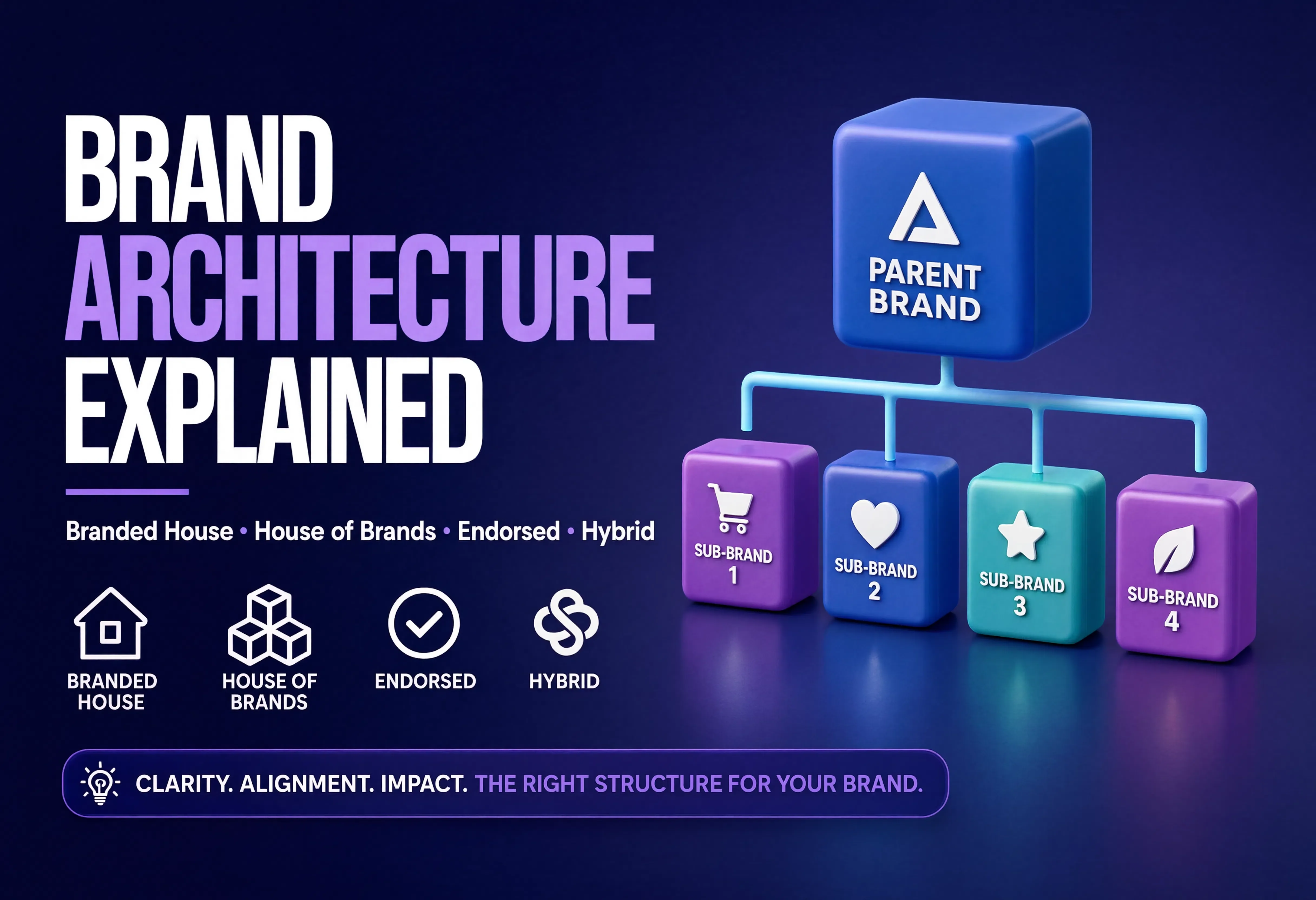
Brand architecture is the structural decision most companies never make on purpose. A new product gets named whatever felt catchy at launch. An acquisition keeps its old name because rebranding seemed expensive at the time. Five years later, nobody can fully explain why the portfolio looks the way it does, and every new naming decision gets made from scratch instead of following a pattern.
There are four recognized models, and choosing one deliberately is one of the highest-leverage decisions in corporate branding, because it determines how risk, credibility, and equity move between your parent company and everything underneath it.
Branded House
One master brand covers every product and service. Google, FedEx, and Virgin are the standard references: Google Maps, Google Drive, and Google Workspace all borrow directly from a single parent identity.
Why companies choose it: Efficiency. Every new product launch starts with inherited trust instead of building awareness from zero. Marketing spend compounds across the whole portfolio instead of being split across disconnected brand names.
The trade-off: A quality or reputation problem in one product can affect perception of the entire brand. When something goes wrong under a Branded House model, it's rarely contained to just the one product.
Best fit for: Companies with a strong, well-defined core identity, a single target market or closely related markets, and a genuine commitment to consistent quality across every offering, since the model has no built-in firewall between products.
House of Brands
The parent company stays largely invisible, and each brand stands entirely on its own. Procter & Gamble's Tide, Gillette, and Pampers don't look related because they aren't meant to. Most customers buying Tide have no idea P&G is behind it.
Why companies choose it: Risk isolation. A problem with one brand doesn't touch the others. It also allows each brand to target a genuinely different audience or price point without diluting a shared identity, useful when a single parent brand can't credibly serve very different customer segments.
The trade-off: Every brand has to build its own equity from zero. There's no shared credibility to borrow, which means significantly higher marketing investment per brand, especially in the early years.
Best fit for: Large, diversified companies with the resources to build multiple independent brands, or companies operating in markets where a shared parent name would actually work against individual product positioning.
Endorsed Branding
Sub-brands keep their own distinct identity but are visibly backed by the parent. Marriott's various hotel brands, each carrying "a Marriott property," is the clearest reference: Courtyard, Residence Inn, and The Ritz-Carlton all read as distinct experiences while still borrowing Marriott's trust and scale.
Why companies choose it: A middle path. Sub-brands get room to develop their own positioning and personality, while still inheriting baseline credibility from the parent, useful when entering adjacent markets or price tiers that would feel inconsistent under a single unified name.
The trade-off: The endorsement itself has to be consistent and clearly communicated, or it stops adding value. An inconsistently applied endorsement confuses customers rather than reassuring them.
Best fit for: Companies expanding into adjacent segments (different price points, different customer types) where full independence isn't necessary, but a single unified brand would feel like a mismatch.
Hybrid
A mix of the above, typically found in large organizations with both flagship brands and acquired brands operating under one umbrella. Microsoft is a common reference point: the core Microsoft brand operates close to a Branded House for products like Microsoft 365 and Teams, while Xbox and LinkedIn operate with much more independence, closer to a House of Brands approach, despite Microsoft owning both.
Why companies choose it: Flexibility, particularly for companies that grow through acquisition. Not every acquired brand needs, or benefits from, immediate integration into the parent identity.
The trade-off: Requires the strongest governance of the four models, since there's no single consistent rule for how sub-brands relate to the parent. Without clear decision-making around when a new acquisition gets absorbed versus kept independent, a hybrid architecture can look like accidental inconsistency rather than deliberate flexibility.
Best fit for: Companies with active M&A strategies, or large organizations that have simply grown complex enough that a single model no longer fits every part of the business.
A Decision Framework
Four questions tend to clarify which model fits:
Is growth primarily organic or acquisition-driven? Organic growth tends to favor Branded House or Endorsed models, since new products are built in-house and can be designed to fit the existing identity from day one. Acquisition-heavy growth often pushes toward House of Brands or Hybrid, since acquired companies arrive with existing brand equity that may be expensive or risky to abandon.
How similar are your target audiences across products? A single, consistent audience supports a Branded House. Genuinely different audiences, different demographics, price sensitivities, or buying behavior, tend to support House of Brands or Endorsed models, where separation allows each product to speak directly to its specific audience.
What's your risk tolerance for cross-contamination? If a single product failure damaging the entire company's reputation is an acceptable risk, Branded House is efficient. If that risk is unacceptable, for example in industries with real safety, financial, or regulatory exposure, House of Brands or Endorsed models create a firewall.
Are you operating in a single market or many, with real cultural or regulatory differences? Multinational companies often need more flexibility than a single strict model allows, since what works as a unified identity in one market may need adaptation in another. This is frequently where Hybrid approaches emerge, even for companies that didn't originally plan for one.
Architecture Migration: When Companies Change Models
Architecture decisions aren't permanent. Companies do migrate between models, usually in response to a specific trigger:
- A House of Brands company facing rising marketing costs per brand sometimes consolidates toward an Endorsed model, adding a parent company endorsement to established sub-brands to reduce the cost of building awareness from scratch for each one.
- A Branded House company that's had a reputation event affecting one product line sometimes moves toward more separation, distancing certain products from the core brand to contain future risk.
- A company built through acquisition, initially a loose Hybrid, sometimes consolidates toward a cleaner Endorsed or Branded House model once the portfolio stabilizes and leadership wants to simplify decision-making around new products.
These migrations are significant undertakings, not quick rebrands, and typically require the same phased rollout discipline as any major brand change: stakeholder alignment first, then a structured transition period rather than an overnight switch.
The Bottom Line
There's no universally correct model. A single-location small business and a multinational holding company will reasonably land on different architectures, and that's fine. The mistake isn't choosing the "wrong" one, it's not choosing deliberately at all, and ending up with a portfolio shaped by a decade of one-off decisions instead of a coherent structure.
For how brand architecture fits into a complete corporate branding strategy, see our full guide to corporate branding strategy.