
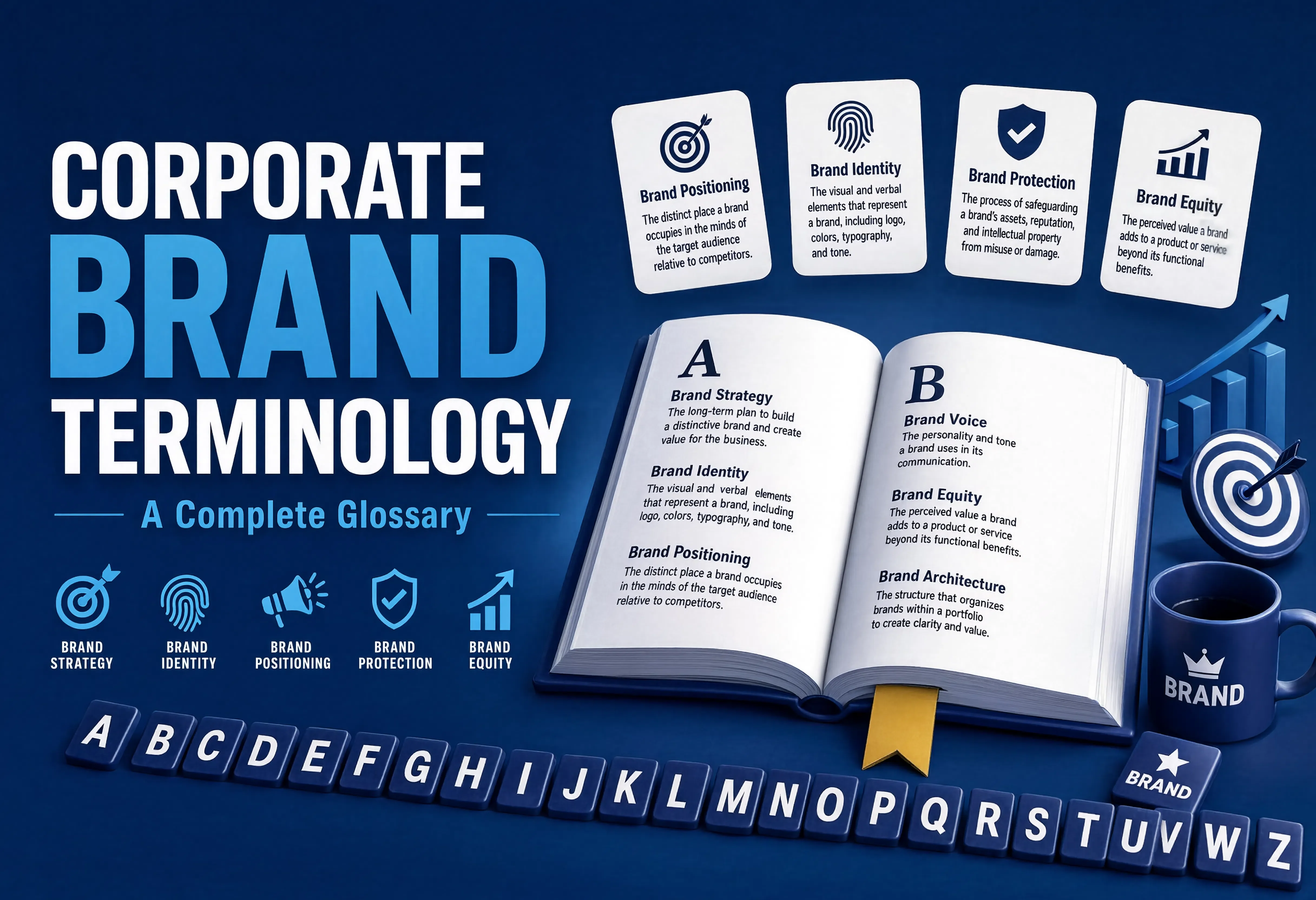
Branding conversations get confusing fast when the same word means different things to different people in the room. This glossary defines the terms that come up most often in corporate branding strategy, organized to be a quick reference rather than another theory-heavy explainer.
Foundational Terms
- Corporate Branding. The long-term strategy shaping how an entire organization is perceived, its purpose, values, and personality, across every market, product, and touchpoint, as distinct from marketing a single product or campaign.
- Brand Strategy. The overarching plan defining a brand's positioning, purpose, audience, and differentiation, which then informs identity, messaging, and marketing execution.
- Brand Identity. The tangible expression of a brand: logo, color palette, typography, imagery style, and voice. Identity is what people see and hear; strategy is why it was designed that way.
- Brand Positioning. The specific place a brand occupies in a customer's mind relative to competitors, typically expressed as a single clear statement of who the brand serves, what category it competes in, and why it's different.
- Brand Promise. The core commitment a brand makes to its customers, the specific value or experience customers can reliably expect every time they interact with the company.
- Brand Purpose. The reason a company exists beyond generating profit. Purpose guides decision-making and, when genuinely specific, differentiates a brand more durably than visual identity alone.
Structure and Governance Terms
- Brand Architecture. How a company structures the relationship between its master brand and its sub-brands or products. See our full breakdown of brand architecture models for the four main types.
- Branded House. A brand architecture model where one master brand covers all products and services, with every offering directly borrowing the parent brand's identity and credibility.
- House of Brands. A brand architecture model where the parent company stays largely invisible and each brand operates independently, with its own distinct identity.
- Endorsed Branding. A brand architecture model where sub-brands keep their own identity but are visibly backed by the parent company's endorsement.
- Brand Governance. The internal rules, ownership structure, and approval processes that keep a brand consistent as more people across a growing organization create content under it.
- Brand Council. A cross-functional group, typically including marketing, HR, product, and sales, responsible for reviewing brand edge cases and approving exceptions to standard guidelines.
- Brand Guidelines. Documented standards covering visual identity (logo usage, color, typography) and verbal identity (tone, messaging) intended to keep brand expression consistent across teams and channels.
Equity and Value Terms
- Brand Equity. The commercial value a brand holds beyond its physical products or services, built from awareness, loyalty, and perceived quality. Brand equity is why customers will pay a premium for one company's product over a functionally similar competitor's.
- Brand Awareness. The extent to which a target audience recognizes and remembers a brand, typically measured as aided recall (recognition when prompted) and unaided recall (recognition without a prompt).
- Share of Voice. A brand's visibility relative to named competitors across media coverage, social conversation, search, or advertising, used as an early indicator of shifting competitive position.
- Net Promoter Score (NPS). A metric measuring customer likelihood to recommend a company, calculated from a single survey question and used as a proxy for overall brand loyalty and satisfaction.
- Brand Sentiment. The emotional tone, positive, negative, or neutral, associated with public conversation about a brand, tracked through social listening and review monitoring.
Messaging and Communication Terms
- Messaging House. A structural framework for organizing brand messaging: the "roof" is the core brand promise in a single sentence, the "pillars" are the top supporting messages, and the "foundation" is the proof points backing each pillar.
- Tone of Voice. The consistent personality and style a brand uses in its written and spoken communication, distinct from what a brand says (messaging) but shaping how it's said.
- Brand Story. The narrative a company uses to communicate its mission and values in a way that's memorable and emotionally resonant, rather than purely factual or transactional.
- Employer Branding. How a company presents itself to current and prospective employees, increasingly overlapping with consumer-facing branding since platforms like LinkedIn and Glassdoor put both audiences in front of the same content.
Process and Lifecycle Terms
- Brand Audit. A structured review of a company's current brand presentation across every touchpoint, comparing intended positioning against how the brand is actually being experienced, typically the first step in any major brand strategy update.
- Rebranding. A significant, deliberate change to a company's identity, messaging, or positioning, usually triggered by a strategic pivot, reputation repair, a merger, or expansion into a new market with different needs.
- Brand Migration. The transitional process of moving customers, partners, and internal systems from an old brand identity to a new one, particularly relevant during rebrands or M&A integration, and rarely an overnight switch in practice.
- Brand Consistency. The degree to which a brand's presentation, visual, verbal, and experiential, remains uniform across every channel and touchpoint. Research consistently links high brand consistency to measurable revenue impact.
The Bottom Line
Clear terminology makes brand strategy conversations faster and less prone to miscommunication, particularly across departments that don't work with these concepts daily. Bookmark this glossary as a quick reference alongside our complete guide to corporate branding strategy, which covers how these concepts work together in practice.