
Introduction: The Rise of AI-Driven Marketing
The field of marketing is currently being revolutionized with the help of artificial intelligence since the technology alters ways of content creation, consumer analysis, data processing, and campaign management. AI tools can generate social media posts, ads, personal recommendations, trends identification, and customer interactions literally in a few seconds. With the help of such instruments, brands can save their resources, minimize expenses, and maintain their online presence. The adoption of AI by thousands of businesses means that the technology is not an advantage anymore because many companies are using similar AI tools to create quality content. In such a way, using only AI cannot guarantee engagement and visibility for businesses anymore.
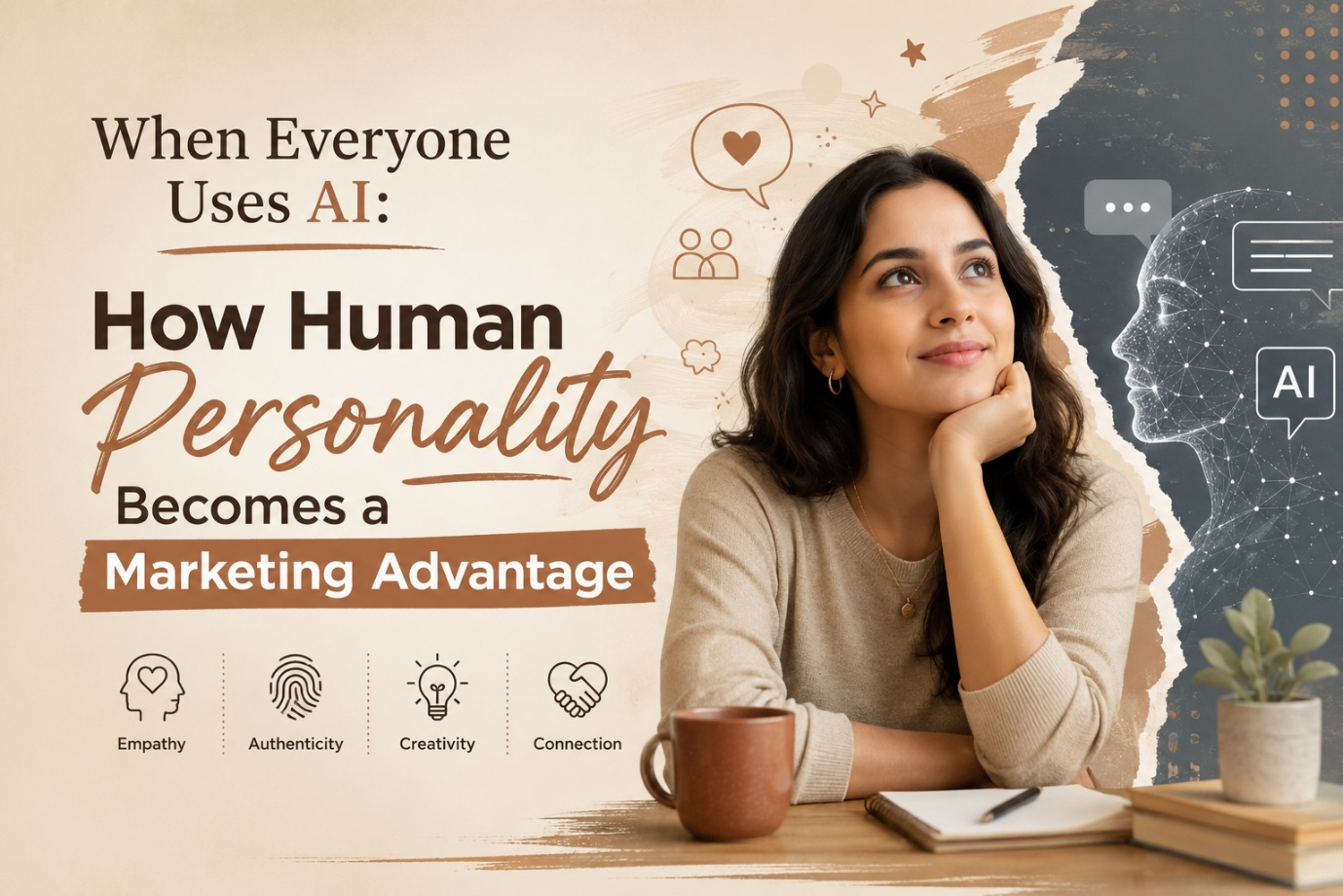
This situation is leading to quite interesting tendencies in the marketing industry. Even though the use of AI increases efficiency and scale of activities, this tool cannot substitute such human characteristics as experience, opinion, emotions, and personality. People become overwhelmed with massive amounts of optimized content. Thus, human features of communication become visible and important for consumers who want to trust the brand. A brand's unique voice, unique story, human perspective, and human interaction are quickly becoming the real differentiator in a market where everyone has access to the same AI tools.
Why Human Personality Matters in an AI-Saturated Market
With the increase of the amount of AI-generated content, consumers might experience difficulties in recognizing which brands communicate through real personalities, and which ones utilize AI-generated content only. Personality could be the source of emotion that standardized AI-generated content lacks. Brands that have their own unique voice, humor, set of values, opinions, and communication style create an identity different from competitors. Instead of giving only informative messages, these brands give reasons for audiences to remember them.
The second benefit that personality can bring to businesses in the modern world is related to emotions. Often people like to hear some stories, experience, humorous and vulnerable moments, which show that people are involved in creating messages. It can be seen in the stories told by a founder about their business mistakes or the experiences of employees in using products to solve some issues.
In the situation of the development of technologies and the saturation of the market with the same type of technology, AI-generated content, algorithms, and other things that are similar for all companies, the human quality could become a competitive advantage. It is impossible for other organizations to create the same personality in their communications with consumers.
Authenticity as the New Competitive Advantage
Authenticity is becoming increasingly vital in light of an increasing number of automated marketing messages that consumers receive on various websites, social media channels, emails, and online advertising. AI technology can generate grammar-correct and strategically optimized content; however, customers might desire communication that is authentic and personally relevant. Authentic marketing does not have to be about disclosing all information about the organization. It is all about being honest, consistent, and true to oneself, which is the same principle we cover in our own breakdown of the psychology behind corporate branding.
An organization can show its authenticity by disclosing behind-the-scenes experiences, insights of employees, experiences of customers, difficulties faced, accomplishments achieved, and lessons learned. All of these things make flaws in the company’s image and make it seem more relatable. At the same time, authenticity might help develop trust since customers find it easier to relate to brands that seem transparent rather than promotional.
This provides a key opportunity for marketers. With advances in AI making it easy to produce generic content, distinct content can be very valuable. While competitors have access to the same AI tools as you do, there is plenty that can distinguish a brand, its tone, its experiences, its values, and its unique culture. According to Consegic Business Intelligence, the growing adoption of AI in interactive advertising is enabling hyper-personalized content, customer insights, and real-time campaign optimization, making authentic human engagement an increasingly important differentiator for brands. Therefore, marketers should adopt AI in improving research and content creation but keep the control of the message in human hands.
How Brands Can Use Human Stories to Build Stronger Connections
The human side of the brands offers marketers a good tool to infuse personality into the marketing message. Instead of talking only about the product itself, companies may tell a story about who created the product or service, what problems and struggles people experienced in the process, or why the business has made a particular decision, an approach we explore further in our complete guide to strategic self branding.
In addition to making the content more interesting, storytelling can help marketers to explain some complex details in a simple and comprehensible way. Instead of providing statistics and technical details, companies may give some context to them and relate them to real-life situations. For example, a technological brand can explain how its technology solved some problems of another small company.
As for social media platforms, they are especially convenient to use when telling stories about people. Videos, interviews, office moments, personal opinions, and interactions with customers may humanize any corporation's communication. AI can be helpful to generate the script, edit the video, conduct some research, and develop a strategy for content. However, people's experiences must be used as the source of content anyway, and when they do so, companies become unique and more recognizable for their customers.
The Future of Marketing: Balancing AI Efficiency with Human Creativity
For the future of marketing, neither fully man-made nor fully AI-powered approaches are expected. Successful companies would merge the AI tools with the human element, including creativity, intuition and personality. AI is able to perform repetitive, data-heavy work such as analyzing consumer behavior, identifying trends, generating first drafts of content, segmenting the audience, communicating automatically. This way, marketers would have more time to develop strategy, creative solutions, relationships, and overall brand experience.
The participation of humans in the process is crucial since marketing needs to consider the context, show empathy, cultural knowledge, and emotions. A marketer would be able to detect when the message could be perceived as offensive, know why the story is important for the audience, or add a new dimension of creative thinking, a shift we outline in more detail in our look at corporate branding in 2026.
With growing availability of AI technology, there is a chance that originality might stem from the creators of technology rather than the technology itself. Companies that create unique voices and inspire their employees to share their authentic viewpoints can build the kind of lasting brand authority that automated content alone cannot achieve. Hence, competitive edge will be achieved by applying AI for scale while leveraging human personalities for significance, credibility, and emotional connections. In this setting, marketers who are going to succeed will not compete with AI but will leverage it while ensuring human touch.
Conclusion
As more and more brands implement AI into their marketing strategies, just having advanced technology won’t be enough for standing out from others. It is possible for companies to utilize AI for enhancing efficiency, analyzing information, automating processes and scaling content creation; however, a personality of a human is necessary for creating trust and emotional connection. Real voices, personal experience, real stories, and authentic communication can make brands more memorable in this digital era when everything is automated. The key to success for marketing will be to find the right ratio of technological advancements and human creativity.