
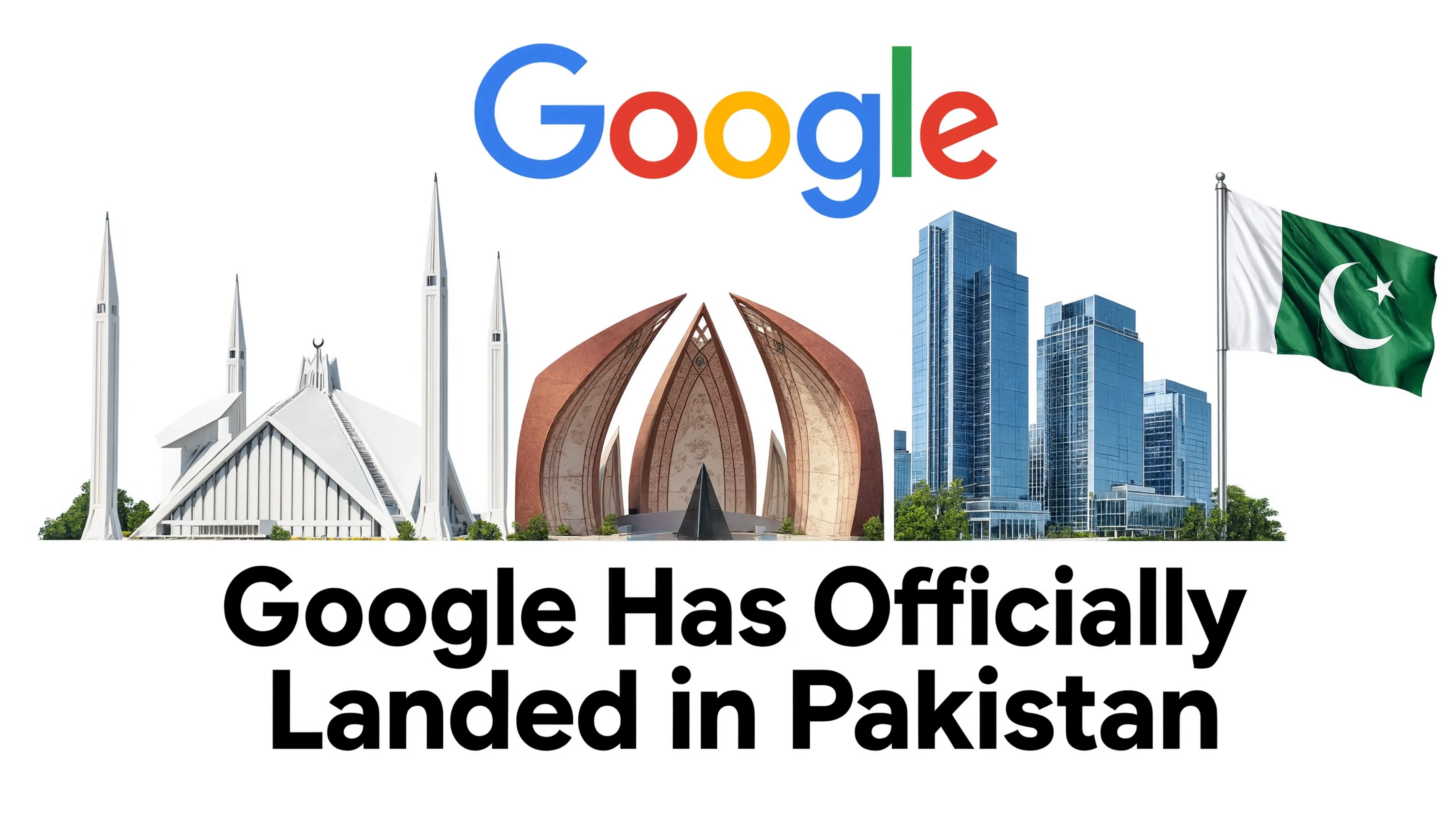
On August 18, 2026, Prime Minister Shehbaz Sharif formally inaugurated Google's first fully functional office in Islamabad, a moment that Pakistan's technology community had anticipated for years and one that the Prime Minister himself described as a "great day" and a "stepping stone to a long journey" of partnership. The event, held with Google Vice President for Global Affairs Wilson White and a nine-member Google delegation, along with US Chargé d'Affaires Natalie Baker in attendance, was more than a ribbon-cutting ceremony. It was a signal, both symbolic and practical, that one of the world's largest technology companies is placing a permanent, physical bet on Pakistan.
For a country that has spent the better part of two decades watching global tech giants set up shop in India, the UAE, Vietnam, and other emerging markets while largely being left off the map, this is a genuinely significant moment. Pakistan is not simply receiving foreign investment; it is being recognized, on Google's own terms, as a market and a talent pool worth building physical infrastructure around.
What Actually Happened
The inauguration took place at the Prime Minister's House in Islamabad, where Shehbaz Sharif and Google's delegation jointly unveiled a plaque marking the office's opening. During the meeting, the Prime Minister welcomed the Google team and described the company as one of the world's leading technology firms. He called the timing "a sheer coincidence," noting that Google's arrival comes precisely as Pakistan is undergoing a major digital transformation of governance, including the digitization of the economy, under the government's "Digital Nation Pakistan" initiative.
Shehbaz briefed the delegation on Pakistan's ongoing programs to train youth in IT and artificial intelligence and reiterated the government's commitment to upgrading the country's digital infrastructure. He pointed to Pakistan's youth bulge as an economic asset waiting to be unlocked, saying the government intends to empower young Pakistanis "through modern tools and technology."
Wilson White, in turn, briefed the Prime Minister on Google's future plans for the country. He said the new local office would deepen Google's commitment to accelerating Pakistan's digital transformation, building on more than a decade of existing partnership, and create long-term opportunities for Pakistani youth and local businesses looking to scale globally.
The Numbers Behind the Announcement
Google didn't arrive with vague promises. White laid out figures that quantify just how large the company's footprint in Pakistan already is, even before this office existed. According to him, Google has generated more than Rs 3.9 trillion in economic activity for Pakistani businesses and households over the past decade, while supporting more than 960,000 jobs across the country.
He also connected Google's strategy directly to Prime Minister Shehbaz's stated ambition of transforming Pakistan into a $30 billion IT export hub, saying the two goals are closely aligned. White outlined three pillars of Google's commitment going forward:
- Investing in Pakistani people: through skilling and upskilling programs designed to prepare the workforce for digital-economy jobs.
- Investing in manufacturing and export infrastructure for hardware: building on the Chromebook assembly line Google has already established in Pakistan through a public-private partnership with a local manufacturing partner.
- Investing in local businesses: helping Pakistani companies use Google's tools and platforms to reach international markets.
On the manufacturing side, White expressed particular satisfaction with the Chromebook assembly line already operating in the country, noting there is strong potential for Chromebooks assembled in Pakistan to be exported to other markets in the region. This is a meaningful detail: it moves the conversation beyond software and cloud services into physical hardware manufacturing, a sector Pakistan has historically struggled to compete in regionally against countries like Vietnam and India.
A Direct Benefit for Students
Perhaps the most immediately tangible announcement to come out of the event was Google's decision to make Gemini, its flagship AI assistant, free for one year for all Pakistani students. In a country where access to premium AI tools is often limited by cost and payment infrastructure, this is a move that could meaningfully widen access to AI-assisted learning, research, and productivity tools for millions of students almost overnight. It also mirrors a broader pattern Google has used elsewhere: seed early, habitual usage among students so that Gemini becomes the default AI tool for an entire generation entering the workforce.
Why This Matters Beyond the Ceremony
It's easy to read stories like this as political theatre; a photo opportunity, a plaque, a few warm quotes exchanged between a Prime Minister and a visiting executive. But there are a few concrete reasons this particular development deserves to be taken seriously.
First, it formalizes a relationship that already existed informally. Google has, by its own account, been active in Pakistan for over a decade through digital ad revenue flowing to Pakistani creators and businesses, YouTube's massive local user base, and various skilling partnerships. What changes with a physical office is accountability and permanence. A registered local presence typically brings closer engagement with regulators, deeper local hiring, and a company that has more skin in the game when it comes to policy conversations around data, taxation, and digital infrastructure.
Second, it arrives at a moment when Pakistan's IT sector desperately needs a credibility boost. Pakistan's IT exports have grown steadily over the past several years, but the sector continues to be held back by challenges including inconsistent internet connectivity, periodic social media restrictions, difficulties in receiving international payments, and a well-documented brain drain of skilled engineers to Gulf countries, Europe, and North America. A company like Google establishing a formal office sends a market signal to other multinational firms, and to Pakistani entrepreneurs themselves, that the operating environment is stable enough to justify long-term investment.
Third, the hardware manufacturing angle is genuinely novel. Much of the commentary around this launch has focused on software, AI access, and digital skilling, and understandably so. But the Chromebook assembly line detail is worth paying closer attention to. If Pakistan can position itself as a regional assembly and export hub for consumer hardware, even in a modest way, that represents a different kind of economic opportunity than software services alone: manufacturing jobs, supply chain development, and export diversification beyond the textile and services sectors Pakistan has traditionally relied on.
Fourth, the timing intersects with Pakistan's own digital governance push. The government's "Digital Nation Pakistan" initiative, along with efforts to digitize public services and the economy more broadly, creates a domestic policy environment that a company like Google can plug into. Shehbaz Sharif's remarks about a "sheer coincidence" of timing suggest the government sees this alignment as an opportunity to accelerate its own digitization agenda using Google's tools, cloud infrastructure, and technical expertise.
The Cautionary Notes
None of this should be read as a guarantee of transformation. Pakistan has seen ambitious tech-sector announcements before that did not fully translate into the scale of change promised at the podium. A few open questions are worth watching over the coming months:
- What does "office" actually mean in practice? Whether this becomes a substantial engineering and product hub, similar to Google's development centers in India, or remains primarily a sales, partnerships, and government-relations office will significantly affect how many high-value jobs it actually creates.
- Will the skilling programs reach beyond major cities? Pakistan's youth bulge is a national asset, but digital opportunity has historically concentrated in Karachi, Lahore, and Islamabad. Programs that genuinely reach smaller cities and rural areas would have a much larger multiplier effect on the economy.
- How will this interact with Pakistan's regulatory environment around internet access and content? Periodic mobile internet shutdowns and platform restrictions in Pakistan have previously created friction for global tech companies and dampened investor confidence. A sustained, predictable digital policy environment will matter more than any single announcement in determining whether Google, and other companies watching this move, deepen their commitment.
- Execution on the $30 billion IT export target. This is a long-standing government ambition that predates this specific announcement, and turning private-sector partnerships into measurable export growth requires sustained follow-through across ministries, not just a single high-profile visit.
The Bigger Picture
Strip away the ceremony and the political framing, and what's left is a fairly clear strategic logic on both sides. For Google, Pakistan represents a market of more than 240 million people, one of the youngest populations in the world, rapidly growing internet and smartphone penetration, and a diaspora-linked digital economy that already generates significant ad revenue and content consumption. Formalizing a local presence lets Google capture more of that value directly, deepen its influence over the country's digital infrastructure choices, and get ahead of competitors in a market that is still relatively under-penetrated compared to India or Southeast Asia.
For Pakistan, the calculation is just as clear. The country needs foreign direct investment, credible anchor partners for its IT export ambitions, and visible proof points that can be used to attract further investment from other multinational technology firms watching how this plays out. A Google office in Islamabad, backed by concrete commitments around AI access, skilling, and hardware manufacturing, gives the government exactly that kind of proof point.
Whether this moment becomes the inflection point it's being framed as will depend far less on the inauguration ceremony itself and much more on what happens over the next 12 to 24 months: how many jobs are actually created, whether the Chromebook manufacturing initiative scales, how many students meaningfully use their free Gemini access, and whether Pakistan's broader digital policy environment becomes stable enough to keep this kind of investment coming. For now, though, the fact that Google chose Islamabad for a formal, physical presence is a milestone worth marking, and one that Pakistan's tech community, entrepreneurs, and young professionals have genuine reason to feel optimistic about.
FAQs
1. When did Google open its office in Pakistan?
Google's first fully functional office in Pakistan was formally inaugurated on August 18, 2026, by Prime Minister Shehbaz Sharif in Islamabad.
2. Where is Google's new office located in Pakistan?
The office is located in Islamabad, Pakistan's capital, and was inaugurated at a ceremony attended by Google's Vice President for Global Affairs and Pakistani government officials.
3. Who inaugurated Google's office in Pakistan?
Prime Minister Shehbaz Sharif formally inaugurated the office, alongside Google Vice President for Global Affairs Wilson White and a nine-member Google delegation.
4. Is this Google's first office in Pakistan?
Yes, this is described as Google's first fully functional, physical office in Pakistan, though the company says it has been active in the country for over a decade through digital services, advertising, and partnerships.
5. Why did Google open an office in Pakistan now?
Google's leadership tied the decision to Pakistan's ongoing digital transformation and the government's "Digital Nation Pakistan" initiative, alongside Prime Minister Shehbaz Sharif's goal of turning Pakistan into a $30 billion IT export hub.
6. How much has Google invested in Pakistan?
Google Vice President Wilson White said the company has generated more than Rs 3.9 trillion in economic activity for Pakistani businesses and households over the past decade.
7. How many jobs has Google supported in Pakistan?
According to Google, its activity in Pakistan has supported more than 960,000 jobs over the past ten years.
8. Is Google Gemini free for students in Pakistan?
Yes. As part of the office launch, Google announced free one-year Gemini subscriptions for all students in Pakistan.
9. How do Pakistani students get free access to Gemini?
Google announced the offer alongside the office inauguration; students should check Google's official channels and the Gemini app/website for eligibility steps and sign-up details as they're rolled out.
10. Does Google manufacture hardware in Pakistan?
Yes. Google has an existing Chromebook assembly line in Pakistan, run through a public-private partnership with a local manufacturing partner, with potential for regional export.
11. What is Pakistan's $30 billion IT export goal?
It's a government target, championed by PM Shehbaz Sharif, to grow Pakistan's IT and IT-enabled services exports to $30 billion. Google says its Pakistan strategy is closely aligned with this goal.
12. What did Google commit to as part of this launch?
Google outlined three commitments: investing in Pakistani talent through skilling programs, investing in manufacturing/export infrastructure for hardware, and investing in local businesses to help them scale internationally.
13. Will Google's Islamabad office create engineering jobs?
This hasn't been detailed publicly. It's unclear whether the office will primarily house sales, partnerships, and government-relations functions or grow into a larger engineering and product hub over time.
14. How does this affect Pakistan's tech and startup ecosystem?
A formal Google presence is widely seen as a credibility signal that could attract further foreign investment, strengthen digital skilling programs, and give local startups and businesses better access to Google's tools, platforms, and support programs.
15. What's next after the office launch?
Google says it will focus on scaling its Pakistan initiatives in collaboration with the government and local digital ecosystem partners, building toward what it calls a "Future Forward Pakistan", one that is more AI-powered and export-driven.